What if AI could make early detection and care coordination as easy as taking a selfie?Born from the shared vision of a sleep apnea patient, a physician, and a technologist, Soliish was created to close a global gap — over one billion people live with undiagnosed sleep disorders like obstructive sleep apnea (OSA) driving chronic conditions like hypertension, diabetes, and heart disease.

Despite advances in digital apps, wearables and diagnostics, pathway to care remains fragmented and complex. Soliish was founded on the belief that technology can bridge innovation and accessibility — empowering both patients and providers.
By combining AI-driven facial analysis, data intelligence, and connected digital workflows, Soliish makes early screening effortless, streamlines care coordination, and helps healthcare teams focus on what matters most: improving lives.
What began as a single question has grown into a mission — to make sleep health more connected, compassionate, and accessible to all.
Population-scale digital screening and early detection of serious health conditions, including Obstructive Sleep Apnea
Leveraging advanced AI to identify health risks before they become critical
Driving early detection of chronic conditions through simple, scalable, and accessible AI
Combining facial analysis and connected digital workflows to help innovators and healthcare providers intervene fast.


If you need technical help or guidance, we’re just an e-mail away.
Find answers to frequently asked questions about our technology and services.
When you fall asleep, the muscles in your throat relax. In people with obstructive sleep apnea (OSA), they relax too much - the airway partially or fully collapses, cutting off airflow. Your brain senses the oxygen drop and briefly wakes you to reopen the airway. This can happen dozens or even hundreds of times per night, each time too briefly for you to remember, but long enough to prevent deep, restorative sleep.
OSA fragments your sleep architecture at a micro level - you may never reach the deep REM stages that make sleep restorative, even if total hours look fine. Many people with undiagnosed OSA describe waking feeling like they barely slept, struggling with afternoon energy crashes, or feeling mentally foggy. Duration alone is not the same as sleep quality.
Yes and this is one of the most common misconceptions. Many people, especially women, experience OSA with minimal or no snoring. Their symptoms tend to be subtler: unexplained fatigue, morning headaches, dry mouth, mood changes, or difficulty concentrating. These get misattributed to stress or aging for years, which is why the average diagnosis delay is 2–5 years.
Untreated OSA is linked to high blood pressure, heart disease, stroke, type 2 diabetes, depression, anxiety, cognitive decline, and increased risk of workplace and vehicle accidents. About 40% of patients develop serious comorbidities before ever being diagnosed - which is why early screening matters so much.
No. While weight is a risk factor, OSA affects people of all body types. Craniofacial anatomy - the shape of your jaw, palate, tongue, and neck - plays a significant role. Thin people with certain facial structures can have severe OSA, while some heavier individuals may have none. This is one reason a face-scan approach that analyzes anatomy offers screening value beyond what a simple symptom questionnaire can provide.
Observed breathing pauses during sleep are one of the strongest indicators of OSA. If someone sleeping nearby has noticed you stop breathing, gasping, or choking during sleep, you should be screened as soon as possible. This is a clinical red flag that warrants professional evaluation.
Soliish's AI analyzes craniofacial features scientifically linked to airway anatomy - things like jawline shape, facial height, midface proportions, tongue position indicators, and neck profile geometry. These structural features correlate with how open or restricted the upper airway is during sleep. The models are trained on peer-reviewed clinical datasets, not general photo data.
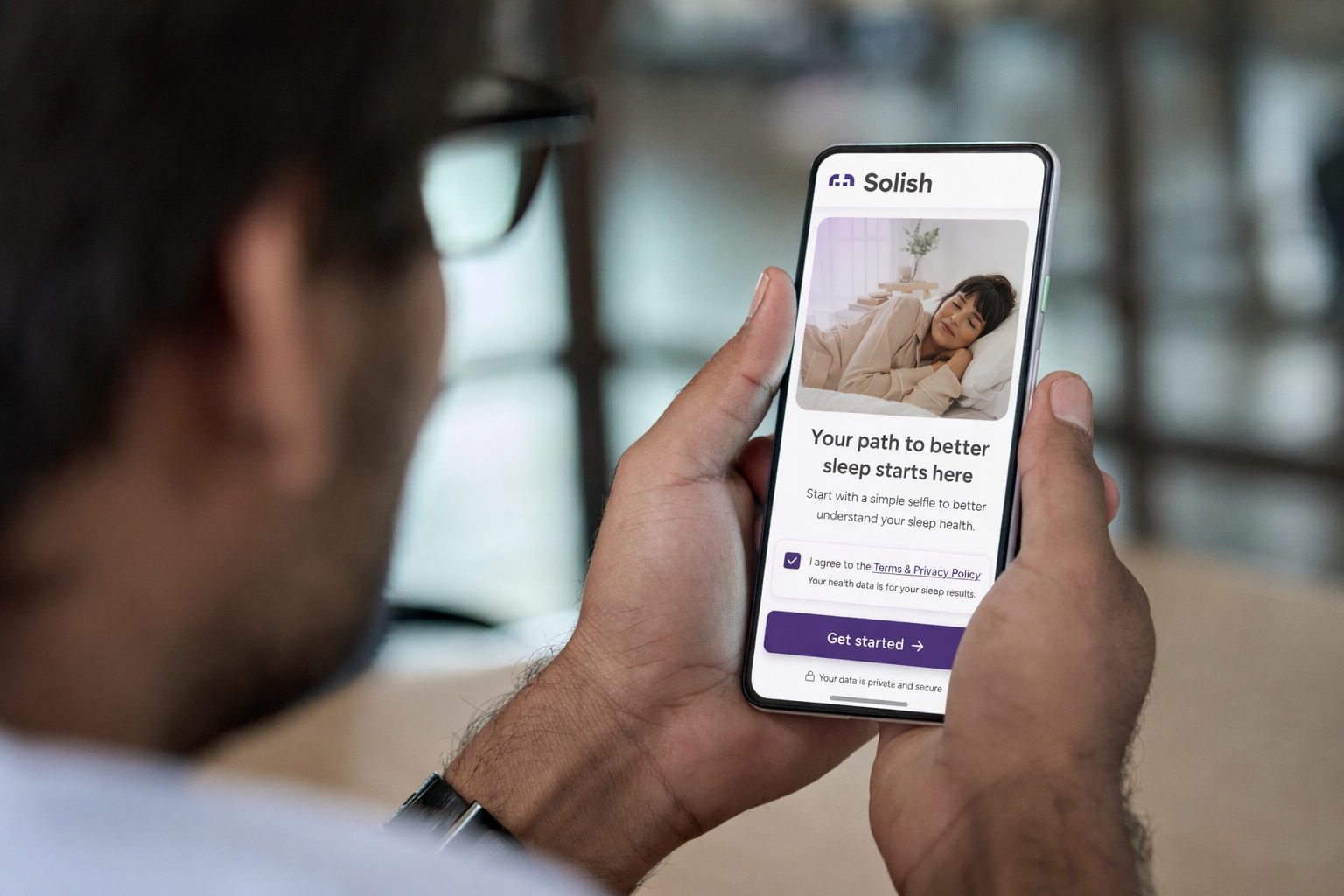
It might seem surprising, but the science behind it is well-established. Research has shown that facial geometry captured in a standard photograph contains measurable predictors of OSA risk. The AI extracts precise geometric measurements from the image that a human eye would miss. The simplicity of the capture is the point - removing friction is what enables screening at scale.
Traditional questionnaires like STOP-BANG rely on self-reported symptoms (snoring, tiredness, blood pressure, neck size) - which means they miss people who don't snore or haven't noticed symptoms yet. Soliish analyzes objective anatomical data, independent of whether you've had noticeable symptoms. It can surface risk in people who would pass a standard questionnaire.
Your facial scan data is used solely to generate your risk assessment. Soliish adheres to strict HIPAA-compliant data handling and does not share your image or biometric data with advertisers or third parties. Full details are available in Soliish's Privacy Policy at soliish.com.
Yes. Soliish works on any smartphone with a front-facing camera, or on a computer with a webcam. No app download is required. The process is browser-based and takes under 60 seconds.
A high-risk result means the AI detected facial features strongly associated with OSA risk. It does not mean you have been diagnosed with sleep apnea - only a sleep study can do that. It does mean you should speak with a healthcare provider and likely undergo a home sleep test or other diagnostic evaluation. Think of it as an important signal, not a verdict.