Every employee wants to perform at their best. They show up ready to contribute, solve problems, and meet expectations.
Every employee wants to perform at their best. They show up ready to contribute, solve problems, and meet expectations.
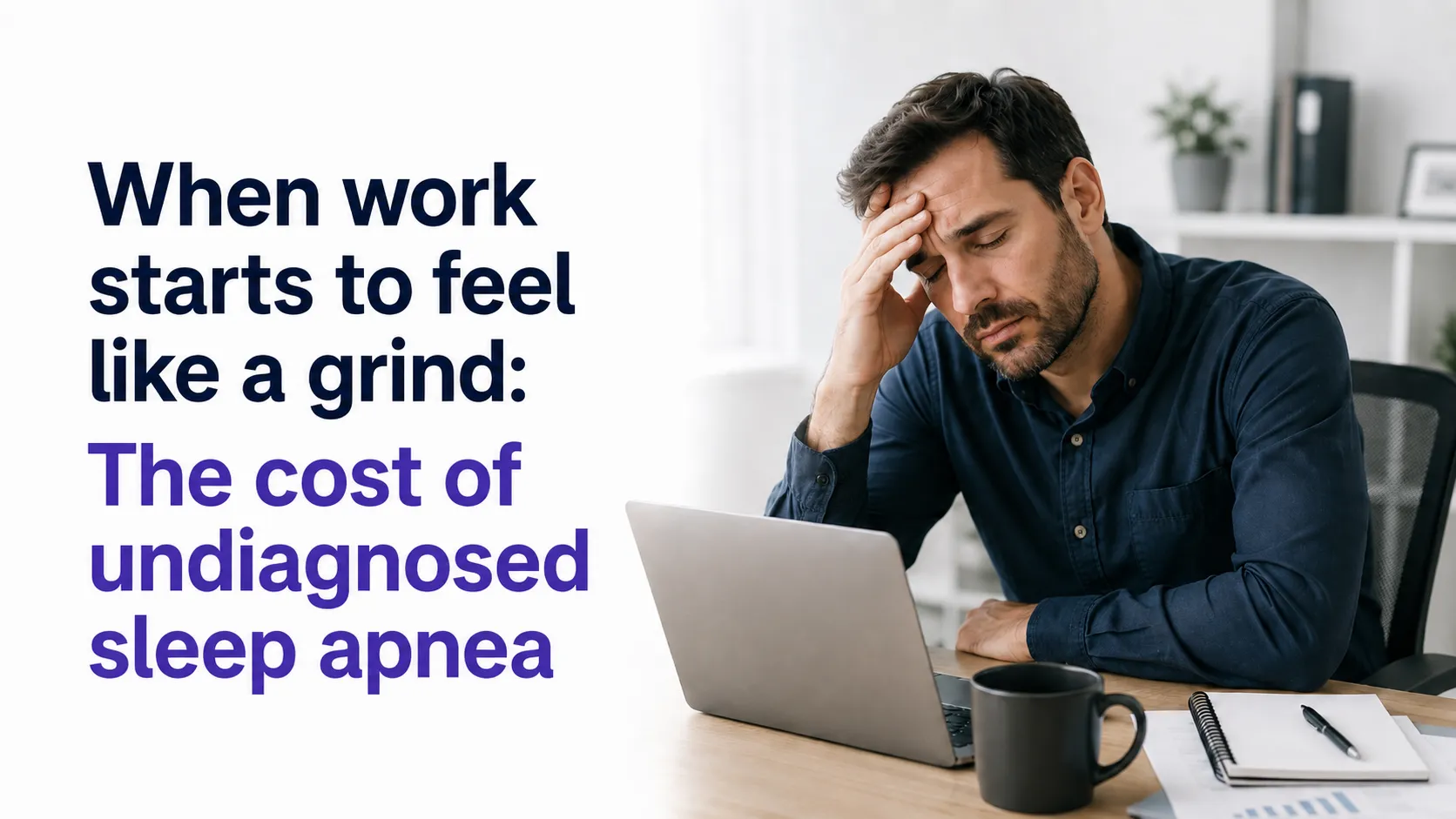
But for millions of workers, something unseen gets in the way. Fatigue at work, mental fog, and lack of focus make simple tasks feel exhausting.
In many cases, the underlying cause is undiagnosed obstructive sleep apnea (OSA).
For employers, this means a workforce that is not working at full capacity. It leads to higher healthcare costs and talent quietly losing interest. All of this happens while the main problem stays hidden.
The business impact of undiagnosed OSA: When your workforce can't perform
A $150 billion wake-up call: According to Frost & Sullivan report, OSA costs the U.S. economy every year1. The biggest cost is productivity loss at $86.9 billion.
When capable employees struggle, employers notice the symptoms long before employees recognize what’s happening:
Rising healthcare costs: Your health plan absorbs rising costs as employees seek care for headaches, anxiety, hypertension, heart disease, type 2 diabetes and other OSA-related issues - without anyone connecting them to the underlying sleep disorder.
Declining productivity: Projects take longer. Quality slips. Employees who were once highly reliable for their work performance start missing deadlines or needing additional oversight.
Increased errors: In jobs that need precision, like analytics, customer service, and safety, poor sleep causes cognitive problems. This can lead to costly mistakes.
Safety incidents: Fatigue-related accidents increase workers' compensation claims and regulatory exposure, especially in manufacturing, transportation, and construction sectors.
Turnover: High performers who can’t maintain their standards often leave or quietly disengage - unaware that a treatable medical condition is undermining them.
You're absorbing real, measurable business consequences from a problem most of your workforce doesn't even know they have.
OSA is uniquely challenging because the employees who need diagnosis most are the least likely to pursue it.
When calendars fill up with deliverables, scheduling medical care feels impossible.
This creates a destructive, self-reinforcing loop:
- Poor sleep quality reduces work performance
- Declining performance increases workload and stress
- Increased demands leave no time for medical evaluation
- Sleep issues worsen as stress compounds the problem
- Performance continues to deteriorate
Your employees get trapped in this loop often for years - while you absorb the productivity losses and healthcare costs. They attribute their struggles to aging, stress, or simply "not being what they used to be."
Unfortunately, the idea that a treatable medical condition is undermining everything rarely enters the equation.
You likely already offer sleep health coverage through your health plan.
The conventional diagnostic process requires:
- Multiple appointments during work hours
- Lengthy wait times for specialists
- Complex coordination of referrals and insurance
- 4-6 months from initial concern to treatment
For overwhelmed, fatigued employees, these requirements prove insurmountable.
Result: 70-80% of employees with OSA remain undiagnosed despite having coverage. You're paying for coverage your workforce cannot successfully utilize.
Traditional sleep pathways require time and bandwidth most employees don’t have. Soliish clears those hurdles through a streamlined diagnostic process delivered with Arima Health’s leading sleep-telehealth team.
No time off required: Digital screening and coordination happen within platforms employees already use. No waiting rooms, no disruption to work schedules or productivity.
Accelerated timeline: What once took 4–6 months now happens in a matter of days. Employees begin treatment early, before motivation fades and without dragging out workplace impact.
Zero administrative burden: Platform handles all coordination - referrals, insurance verification, equipment logistics. Your employees follow clear digital guidance without carrying administrative complexity.
Home-based testing: Sleep studies are conducted in employees' own environments, on their schedules. No lab appointments, no time away from work.
Seamless treatment connection: Direct progression from diagnosis to therapy without DME coordination delays. Treatment begins immediately upon diagnosis.
Result for employers: Dramatically higher completion rates, faster time-to-treatment, and measurable improvements in workforce productivity and health outcomes.
And those operational wins don’t just feel better; they change the numbers. When employees actually complete diagnosis and start treatment, the business impact shows up fast and clearly.
When your workforce successfully completes OSA diagnosis and treatment through Soliish, you see tangible business improvements:
Productivity rebounds: Cognitive function, focus, and energy return to baseline within weeks. The employee who was struggling to meet deadlines becomes capable of tackling complex projects again.
Healthcare costs decline: Early OSA treatment prevents expensive downstream conditions. You avoid the doubled annual costs associated with untreated OSA.
Analysts estimate that diagnosing and treating everyone with sleep apnea in the U.S. could generate roughly 100 billion dollars in annual savings each year.6
Improved retention: Employees who resolve health issues undermining their performance re-engage with their roles instead of leaving. You retain talent and institutional knowledge.
Enhanced safety: Reduced fatigue-related accidents translate directly to lower workers' compensation costs and regulatory risk.
Increased engagement: When work stops feeling like an uphill battle due to chronic exhaustion, employee morale and collaboration improve.
In short, better sleep health isn’t a “nice-to-have” perk; it’s a performance lever. The only question is whether your benefit design helps employees reach treatment, or quietly blocks them from it.
The gap in most workplace health strategies isn't budget - it's execution.
What if OSA diagnosis were something busy employees could actually accomplish alongside their responsibilities?
That’s exactly what Soliish does.
Soliish’s AI face scan estimates sleep apnea risk from a single front-facing selfie. The model extracts craniofacial markers—jaw alignment, midface size, facial proportions, width/depth, and neck region cues—linked to airway obstruction.
Trained against polysomnography outcomes, it outputs a low/moderate/high risk score in just seconds, without devices or lab visits.
This enables fast, non-invasive, scalable screening that fits telehealth and helps people reach testing and treatment earlier.
When the care pathway is fast, simple, and non-disruptive, employees are far more likely to complete it. And when they do, you see the outcomes everywhere: better mental health, higher quality of life, and measurable gains in employees’ performance as they show up to work with real energy again.
Your employees want to perform well. Many cannot because undiagnosed OSA has made work unnecessarily difficult.
Soliish breaks this cycle by redesigning the diagnostic pathway for how your workforce actually operates. Higher completion rates. Faster treatment. Better business outcomes.
Because when work becomes a grind due to untreated sleep apnea, the solution isn’t more incentives or more education - it’s removing the barriers that make getting help impossible.
Discover how Soliish is helping organizations turn sleep health benefits into measurable workforce outcomes.
1. Wickwire EM. Value-based sleep and breathing: health economic aspects of obstructive sleep apnea. Faculty Reviews. 2021.
2. Garvey JF et al. The public health burden of obstructive sleep apnea. Sleep Science. 2021.
3. Silva GE et al. Association between obstructive sleep apnea and multiple involuntary job loss history among recently unemployed adults. Sleep Health. 2021.
4. The economic cost of obstructive sleep apnea: A systematic review. Sleep Medicine Reviews. 2023.
5. Thompson C et al. A portrait of obstructive sleep apnea risk factors in 27, 210 middle-aged and older adults in the Canadian Longitudinal Study on Aging. Scientific Reports. 2022.
6. American Academy of Sleep Medicine (AASM). Economic burden of undiagnosed sleep apnea in U.S. is nearly $150B per year. Press Release. 2016.