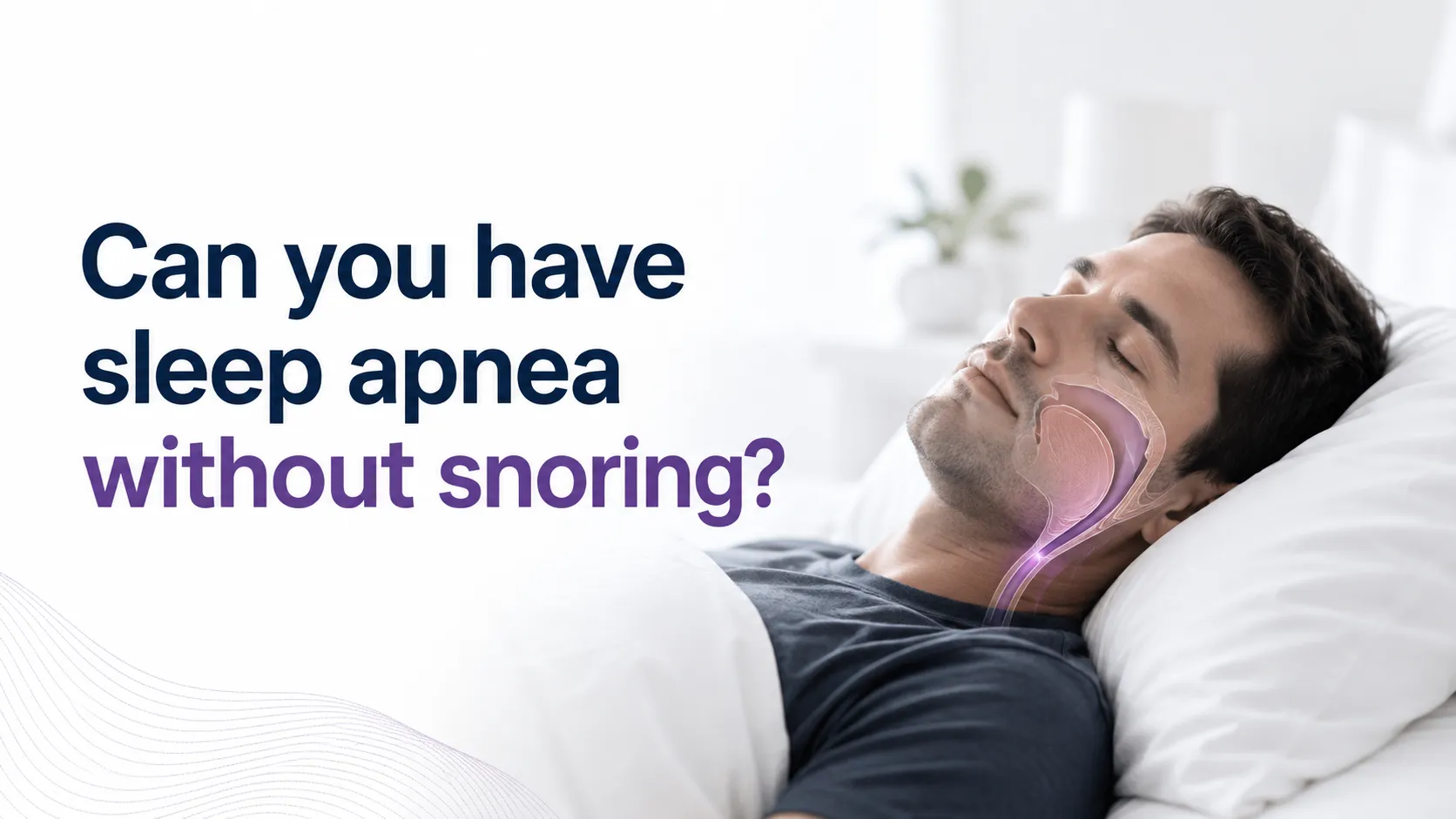
If snoring is the most talked-about symptom of sleep apnea, what happens when it’s not there?
If snoring is the most talked-about symptom of sleep apnea, what happens when it’s not there?
According to the National Heart, Lung, and Blood Institute (NHLBI), sleep apnea is a common sleep disorder in which breathing repeatedly stops and starts during sleep. While snoring is common in people with obstructive sleep apnea, it is not required for the condition to be present.
To better understand why snoring may be absent—and what that can indicate—we spoke with sleep specialist Asim Roy, MD, Chief Medical Officer at Soliish and Managing Partner at the Ohio Sleep Medicine Institute. An expert in clinical trials and in the sleep, neuro, pharma, and medtech spaces, Dr. Roy shared the following insights.
Can you really have sleep apnea without snoring?
Yes and in my experience, this is one of the most misunderstood realities in sleep medicine.
I regularly see patients who are surprised by a sleep apnea diagnosis because they’ve been told or assumed that snoring is required. Many of them don’t snore loudly, some don’t snore consistently, and some don’t snore at all. Yet their sleep studies clearly show repeated breathing interruptions and oxygen drops throughout the night.
So yes, you can absolutely have sleep apnea without snoring.
This is also why early risk awareness matters, especially for people who don’t fit the classic profile. When snoring isn’t present, traditional screening questions often fall short. Newer approaches now look beyond sound alone and focus on anatomical and physiological risk patterns that influence the upper airway during sleep.
Soliish works in this space by using AI-based facial analysis to identify craniofacial features associated with airway narrowing. It helps surface risk earlier and guide decisions about whether a formal sleep study is worth pursuing, particularly in people whose symptoms are quiet, subtle, or easy to dismiss.
.jpg)
Snoring became the public face of sleep apnea because it’s visible or rather, audible.
From a clinical standpoint, snoring is simply the sound created when airflow causes soft tissues in the throat to vibrate. It’s easy for a bed partner to notice and easy for a clinician to ask about in a short visit. Over time, it became shorthand for risk.
But here’s what I often explain to patients: snoring is a symptom of airflow turbulence, not a measure of breathing failure.
Sleep apnea is about repeated airway collapse and oxygen disruption and those events don’t always create sound.
Sleep apnea is defined by physiology, not noise.
What matters clinically are:
I’ve reviewed countless sleep studies where patients had minimal or no snoring but still experienced dozens of breathing events per hour. The body doesn’t care whether those events are loud; it responds to the oxygen loss and sleep disruption the same way.
Several patterns of sleep apnea often involve little or no snoring:
In clinical practice, these are often the cases that take the longest to diagnose not because they’re rare, but because they don’t “look like” what people expect sleep apnea to look like.
This comes down to how the airway collapses.
In many patients I see, the airway narrows quietly rather than fluttering noisily. Contributing factors include:
These patients often tell me, “I sleep quietly, but I wake up exhausted.” And that disconnect is a red flag.
When snoring isn’t present, the daytime symptoms usually tell the story.
Patients commonly describe:
What stands out is how often people say, “I thought this was just stress” or “I assumed this was normal at my age.” It’s not uncommon for these symptoms to persist for years before sleep apnea is considered.
Most screening still relies heavily on:
If someone doesn’t snore, sleeps alone, or isn’t overweight, they’re often unintentionally deprioritized even when their symptoms are significant. There have been many patients reaching out to a diagnosis only after years of unexplained fatigue, mood changes, or cardiovascular issues.
In practice, silent sleep apnea is especially common in:
Diagnosis still requires formal sleep testing, but risk awareness should come earlier.
In recent years, we’ve begun to use tools that look beyond snoring and BMI including AI-based facial analysis that assesses craniofacial markers linked to airway obstruction. These tools can flag risk patterns that traditional questionnaires overlook.
For patients who don’t snore, this kind of screening can be a useful first step toward deciding whether deeper evaluation makes sense.
No, and this is a critical point.
The body responds to oxygen drops and repeated arousals, not volume. I’ve seen patients with very quiet sleep apnea develop:
Silence does not equal safety.
It is highly recommended that you consult a sleep doctor when you have:
You don’t need loud symptoms to justify clarity.
I always tell my patients, “Don’t listen for noise, listen to how you feel.”
Sleep apnea often announces itself quietly through exhaustion, cognitive drag, and emotional strain long before anyone hears snoring. Recognizing that sleep apnea can exist without snoring allows people to seek answers earlier and avoid years of unnecessary struggle.
Understanding risk isn’t about jumping to treatment. It’s about replacing assumptions with insight.
This is why modern sleep health is moving beyond sound alone and toward earlier, more inclusive risk awareness. By looking at symptoms, physiology, and anatomical factors together, it becomes possible to identify people who might otherwise remain undiagnosed for years.
Newer approaches, such as Soliish, play a valuable role here. By helping identify anatomical and physiological risk patterns early, Soliish supports more informed decisions about whether further sleep evaluation may be needed particularly for people whose symptoms don’t fit traditional stereotypes.
Better sleep doesn’t start with assumptions. It starts with understanding risk, asking the right questions, and using the right tools to move from uncertainty to clarity.