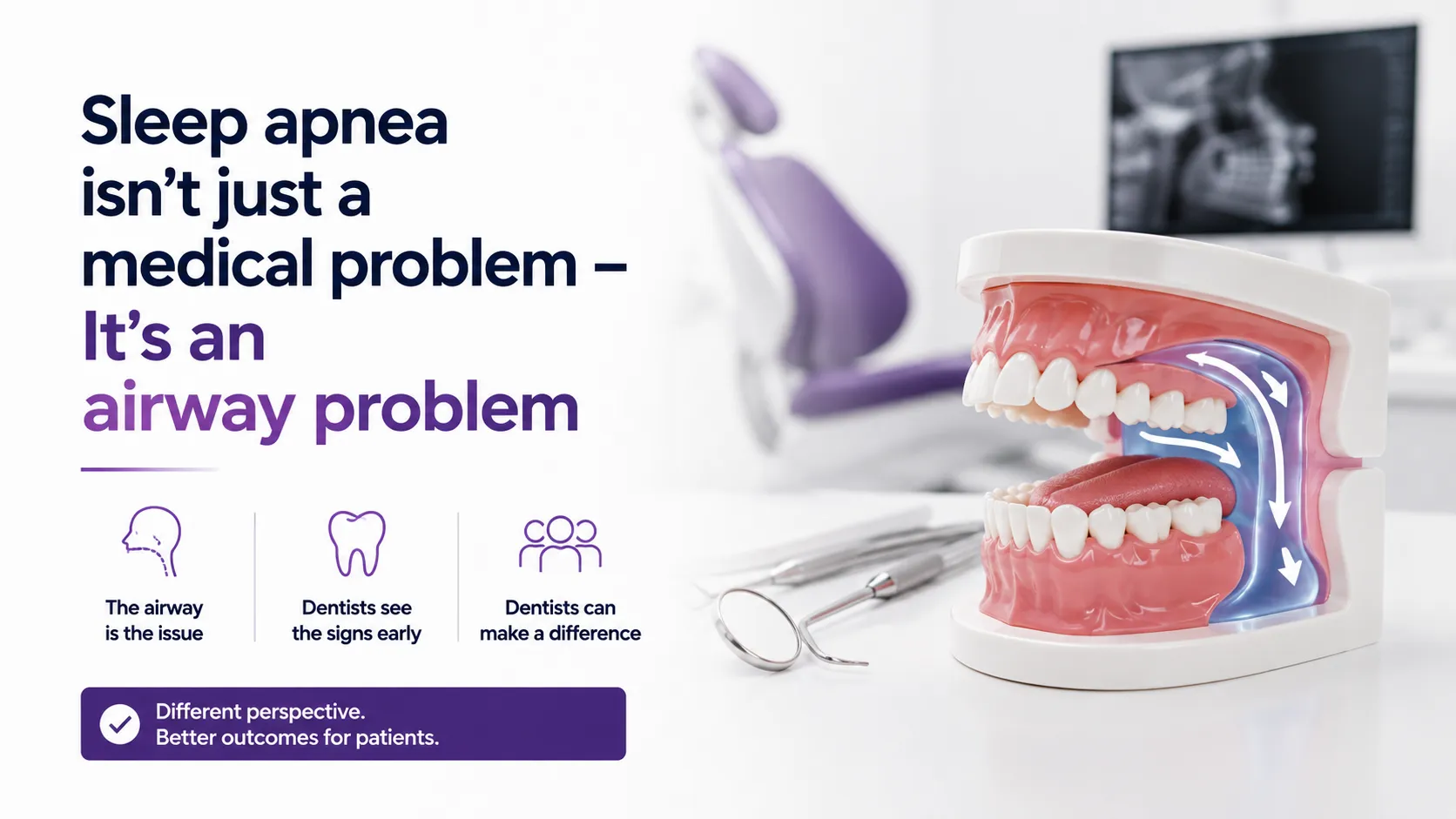
Sleep apnea is usually introduced as a medical diagnosis. It’s discussed in terms of sleep studies, AHI scores, and long-term health risks.
Sleep apnea is usually introduced as a medical diagnosis. It’s discussed in terms of sleep studies, AHI scores, and long-term health risks. All of that is accurate, but it’s not the full picture.
At its core, obstructive sleep apnea is a breathing problem that occurs during sleep. More specifically, it’s a problem of airway size, shape, and stability when the body relaxes. Framing it this way helps explain why sleep apnea shows up across so many clinical settings and why dentistry keeps intersecting with it.
This perspective doesn’t change who diagnoses or treats sleep apnea. Diagnosis remains medical. Treatment decisions remain clinical. But understanding sleep apnea as an airway problem clarifies why certain patients are at risk and why those risks can be visible outside a sleep clinic.
What actually happens in obstructive sleep apnea
During sleep, muscle tone throughout the body decreases. That includes the muscles that help keep the upper airway open. In some people, this relaxation causes the airway to narrow or collapse repeatedly throughout the night.
When airflow drops or stops, oxygen levels fall. The brain responds by briefly arousing the body just enough to reopen the airway. These arousals are often so short that patients don’t remember them—but they fragment sleep and place repeated stress on the cardiovascular and nervous systems.
This cycle can happen dozens or even hundreds of times per night.
From a medical standpoint, this pattern is confirmed through sleep testing and measured through established criteria. From a structural standpoint, it raises a simpler question: how much space does the airway have when everything relaxes?
Airway size and stability are influenced by many factors. Weight and soft tissue volume play a role, but they are not the only determinants—and they are not always the most important ones.
The upper airway is not a rigid tube. It’s a dynamic space surrounded by bone, muscle, and soft tissue. Small differences in structure can have outsized effects once gravity, muscle relaxation, and sleep position are introduced.
This is why sleep apnea can appear in people who don’t match the stereotypical profile. Some patients are not overweight. Some don’t report loud snoring. Some primarily complain of fatigue, headaches, or poor concentration rather than sleepiness.
Seen through an airway lens, these cases make more sense.
Dentistry has always worked around the airway, even when sleep wasn’t the focus.
Dental clinicians routinely assess how the jaws relate to one another, how much space exists within the oral cavity, and how soft tissues behave during function. These observations are made to support dental health, comfort, and long-term outcomes—not to diagnose sleep disorders.
But the same structures that influence occlusion, wear patterns, and oral comfort also influence airway space during sleep.
This overlap explains why dentists often encounter patients who raise sleep-related concerns long before a diagnosis is ever made. It also explains why screening for sleep apnea risk can occur responsibly in dental settings without turning dentistry into sleep medicine.
Understanding sleep apnea as an airway problem does not expand dental scope. It simply clarifies why dentistry is adjacent to early risk identification.
It’s important to be precise here.
Recognizing that sleep apnea is an airway problem, it does not change how it is diagnosed. Diagnosis requires sleep testing either at home or in a lab, and clinical interpretation by a licensed physician.
Airway anatomy alone cannot confirm sleep apnea. Breathing patterns, oxygen levels, and sleep architecture must be measured over time. That is why screening is not diagnosis, and why observation or risk identification must always lead to proper medical evaluation.
The airway framing helps explain risk, not disease.
Traditional screening approaches often emphasize factors like body mass index, age, or self-reported sleepiness. These factors are useful, but they don’t capture everyone at risk.
Many patients, particularly women and individuals with certain craniofacial structures are under-identified when screening relies too heavily on weight or classic symptom presentation.
An airway-based understanding helps explain these gaps. Structural contributors to airway narrowing don’t always announce themselves through obvious symptoms. They can quietly increase vulnerability, especially when combined with age, hormonal changes, or sleep position.
This is one reason early, anatomy-informed screening can be helpful in identifying patients who might otherwise be overlooked.
Viewing sleep apnea as an airway problem does not blur professional boundaries, it reinforces them.
Each role remains distinct. The airway framing simply provides a clearer explanation for why those roles intersect.
Sleep apnea is a medical diagnosis, but it is rooted in airway anatomy and physiology. Recognizing that reality helps explain why dentistry continues to encounter sleep apnea risk in routine care, and why early identification often begins outside a sleep clinic.
This perspective doesn’t ask dentists to diagnose or treat sleep apnea independently. It asks for awareness, appropriate screening, and clear referral into medical evaluation when risk appears present.
Understanding sleep apnea as an airway problem doesn’t change who is responsible for care. It clarifies how different clinicians contribute responsibly, each within their scope, to better patient outcomes.