10 min read

Sleep apnea screening at home:Comparing questionnaires, wearables, and AI selfie face scans

Published on
4 Mar 2026

If you have ever Googled your symptoms at 11 p.m. and ended up down a sleep apnea rabbit hole, you have probably also discovered that the diagnostic options seem to range from "fill out a questionnaire" to "spend the night in a hospital with electrodes taped to your head."

The good news: there is now a wider and more accessible range of home screening tools than ever before - from decade-old symptom questionnaires to FDA-cleared smartwatches to a new generation of AI face scan tools that require nothing more than a selfie camera. The challenge is knowing what each tool actually does, how accurate it is, and critically which one is the right starting point for you.

This guide breaks down every major home sleep apnea screening method with honest accuracy data, real costs, and a clear side-by-side comparison so you can make an informed decision.

Bottom Line Up Front: No single at-home screening tool replaces a clinical diagnosis. But the right tool can tell you whether you need one and that step alone changes everything for the roughly 80% of people with OSA who have never been tested.

Why Home Sleep Apnea Screening Matters

Obstructive sleep apnea affects an estimated one billion people worldwide, according to a widely-cited systematic review in The Lancet Respiratory Medicine. In the United States alone, the American Academy of Sleep Medicine estimates nearly 30 million adults are affected yet the vast majority remain undiagnosed. The commonly cited figure is that around 80% of moderate-to-severe OSA cases go undetected.

The consequences of going undiagnosed are serious. Untreated OSA is independently associated with hypertension, cardiovascular disease, type 2 diabetes, stroke, cognitive impairment, and significantly elevated risk of motor vehicle accidents. Early identification and treatment with CPAP, oral appliances, or lifestyle changes can reverse or mitigate many of these risks.

The bottleneck is access. Polysomnography, the clinical gold standard requires a specialist referral, an overnight stay in a sleep lab, and costs between $1,000 and $3,500. Even home sleep apnea tests require a physician's prescription. For most people, the journey to diagnosis never starts because the first step feels too high.

That is where home screening tools come in, not to replace clinical diagnosis, but to lower the barrier enough that people who need testing actually seek it.

Method 1: Sleep apnea questionnaires

Questionnaires are the oldest and most widely used screening tools for OSA in clinical settings. The three most common are:

  • STOP-BANG Questionnaire: An 8-item yes/no tool covering snoring, tiredness, observed apnea, blood pressure, BMI, age, neck circumference, and gender. A score of 3 or more indicates elevated risk.
  • Epworth Sleepiness Scale (ESS): Measures subjective daytime sleepiness across 8 everyday scenarios on a 0–3 scale. A total score above 10 suggests excessive daytime sleepiness.
  • Berlin Questionnaire: A 10-item tool covering snoring frequency, daytime sleepiness, and hypertension/obesity history.

Accuracy

The STOP-BANG is the most widely validated questionnaire and performs best in clinical populations with suspected OSA. Across multiple independent studies and meta-analyses:

  • STOP-BANG: 81.6% sensitivity, 75% specificity (Chiu et al. meta-analysis, Sleep Medicine Reviews)
  • Berlin Questionnaire: 78.7% sensitivity, 61.9% specificity
  • Epworth Sleepiness Scale (ESS): 34.5% sensitivity, 82.6% specificity

The ESS numbers are particularly telling: the scale identifies daytime sleepiness well (high specificity) but misses a large proportion of OSA cases (very low sensitivity). This is because many people with significant OSA do not recognise how sleepy they actually are rather they have adapted to chronically poor sleep quality over years or decades.

Key limitations

  • Entirely subjective: Every data point is self-reported. Patients who do not snore loudly, do not feel sleepy, or have anatomically driven OSA without classic obesity-related markers will routinely score below the threshold even with severe OSA.
  • Misses the non-obese patient: STOP-BANG includes BMI, age, and neck circumference as variables. It was validated primarily on clinical populations skewed toward overweight, middle-aged men, the classic OSA demographic. It performs significantly worse for women, younger adults, and non-obese individuals with anatomy-driven OSA.
  • No objective measurement: Questionnaires cannot measure what is physically happening in a patient's airway or facial anatomy.

Cost and accessibility

Free. All three questionnaires are publicly available online and take 3–5 minutes to complete. They are widely used in primary care as a first triage step before referring for diagnostic testing.

Best for: People who want a very quick, zero-barrier first check especially in clinical settings. Weakest for non-obese individuals, women, and anyone whose OSA is driven primarily by anatomy rather than BMI or lifestyle factors.

Method 2: Consumer wearables

Consumer wearables primarily smartwatches and smart rings have evolved significantly as sleep health monitoring tools. Unlike questionnaires, they collect objective physiological data overnight. The most commonly used devices for sleep apnea risk monitoring include:

  • Apple Watch (Series 9, 10, Ultra 2): Received FDA clearance for its Breathing Disturbances feature in September 2024. Tracks wrist motion, heart rate, and blood oxygen to detect breathing irregularities during sleep.
  • Samsung Galaxy Watch 7 / Ultra: The first smartphone-linked app to receive FDA approval for sleep apnea detection, cleared in February 2024. Uses accelerometer and SpO2 sensors.
  • Oura Ring (Gen 3): Tracks sleep stages, heart rate variability, respiratory rate, and blood oxygen from the finger. No FDA clearance specifically for sleep apnea detection, but widely used for sleep monitoring.
  • Withings Sleep Analyzer: An under-mattress device that records breathing patterns and has received FDA clearance as a sleep apnea detection tool.

Accuracy

Wearable accuracy varies significantly by what is being measured. For general sleep staging, a 2024 Brigham and Women's Hospital study published in Sensors found:

  • Oura Ring Gen3: 79% agreement with PSG in four-stage sleep classification (Cohen's kappa: 0.65)
  • Apple Watch Series 8: 74% agreement (Cohen's kappa: 0.60)
  • Fitbit Sense 2: 69% agreement (Cohen's kappa: 0.55)

For sleep apnea detection specifically, a 2024 study found that newer-generation smartwatches correctly flagged OSA risk in 75–96% of users who were later confirmed to have OSA. However, performance drops significantly for mild OSA - wearables detect events better as severity increases.

An important caveat: wearables detect physiological consequences of OSA - breathing disruptions, oxygen desaturations, heart rate anomalies rather than the structural causes of OSA. This means they require the condition to already be causing nighttime events in order to detect it.

Key limitations

  • Must already be experiencing events: A wearable can only detect OSA if it is already causing detectable breathing disruptions during the night of monitoring. The anatomy that will cause problems is invisible to a wrist or finger sensor.
  • Requires nightly wear: The device must be worn overnight for meaningful data. A single night may not capture the full picture, particularly for positional or REM-related OSA that varies night to night.
  • Not diagnostic: FDA-cleared wearables flag breathing disturbances; they do not diagnose OSA. A positive alert requires follow-up with a clinician and formal testing.
  • Cost: Apple Watch starts at around $400. Oura Ring is $299 plus a subscription fee. These are meaningful financial barriers for many users.
  • Overestimation risk: Studies have found Apple Watch overestimates light sleep by an average of 45 minutes and deep sleep by 43 minutes per night, suggesting some caution is warranted in interpreting data.

Cost and accessibility

Apple Watch: $399–$799. Oura Ring: $299 + $5.99/month subscription. Samsung Galaxy Watch: $299–$649. Withings Sleep Analyzer: $129. No prescription required for consumer versions; FDA-cleared diagnostic wearables (WatchPAT, etc.) require clinical prescription.

Best for: People who already own a compatible smartwatch, or who are willing to invest in overnight monitoring for ongoing tracking. Particularly useful for identifying active breathing disturbances and trending sleep quality over time. Less useful for identifying structural risk before symptoms develop.

Method 3: AI selfie face scan (e.g., FaceX by Soliish)

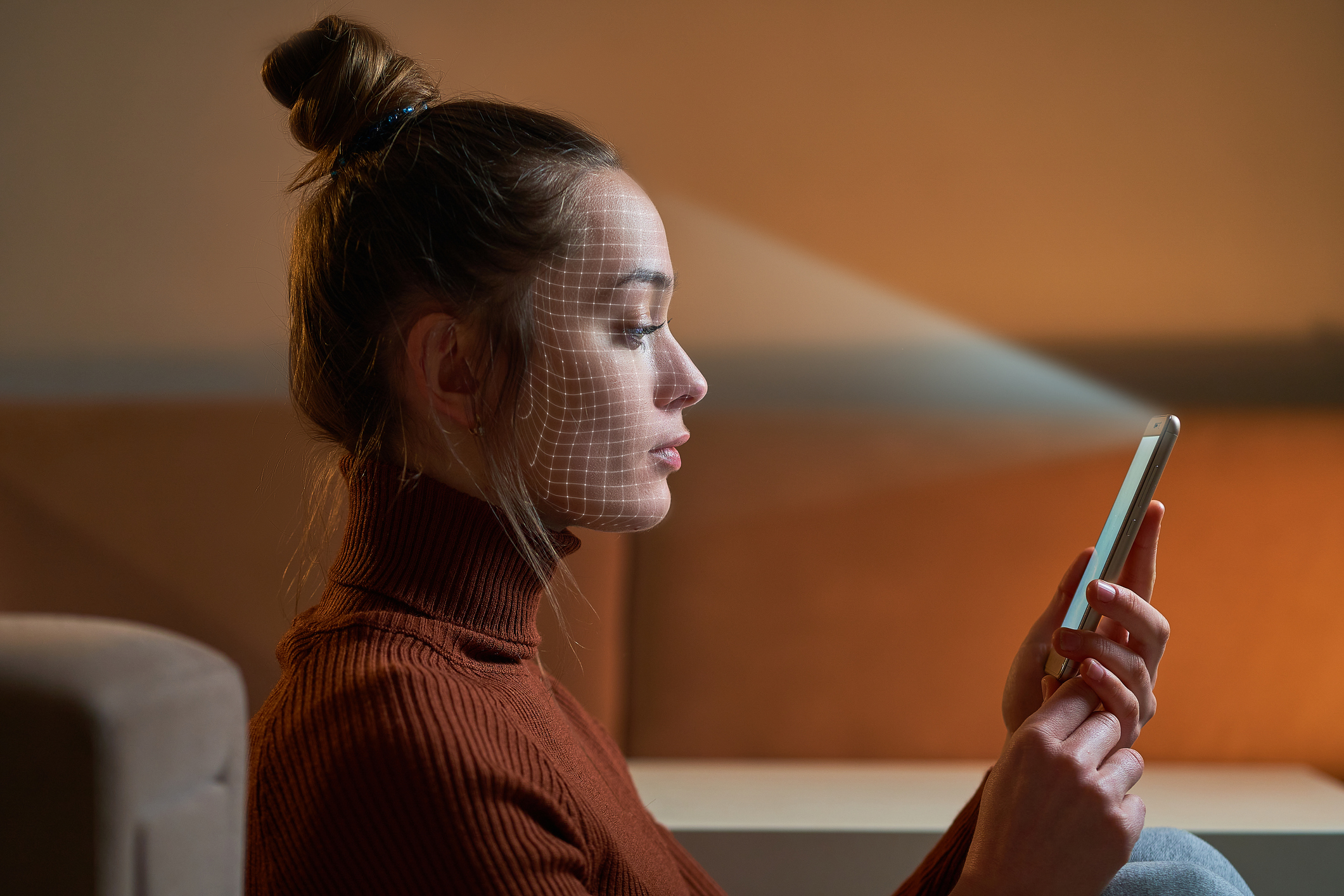
AI face scan tools for sleep apnea screening such as FaceX by Soliish analyzes the structural features of your face using a convolutional neural network (CNN) trained on clinical datasets with polysomnography-confirmed OSA diagnoses. The scan takes a front-facing photograph through your phone or webcam and detects craniofacial risk markers associated with obstructive sleep apnea.

The science behind this approach is well-established: OSA is fundamentally a structural disorder. Anatomical features including retrognathia (a recessed jaw), neck dimensions, midface development, and palate shape determine upper airway geometry and upper airway geometry determines OSA risk. These features are measurable in standard photographs.

Accuracy

The AI selfie scan evidence base has grown rapidly, with multiple peer-reviewed studies now published:

  • 84.9% pooled sensitivity, 71.2% pooled specificity: A 2024 Bayesian meta-analysis (Gao et al., Sleep and Breathing) pooled 6 studies, 10 AI models, and 2,400 participants. Deep learning CNN models reached 91.1% sensitivity and 79.2% specificity.
  • 88.4% accuracy from photographs alone: He et al. (Sleep Medicine, 2023) trained a deep learning model on 530 participants and achieved 88.4% accuracy and AUC of 0.881 from craniofacial photos.
  • Outperforms questionnaires for non-obese patients: Park et al. (Journal of Clinical Sleep Medicine, 2025) found that combining AI facial analysis with questionnaires significantly outperformed questionnaire-only screening, with particularly strong gains in non-obese patients.
  • Comparable to HSAT for risk stratification: Deep learning models achieved sensitivity approaching that of FDA-cleared home sleep tests with zero equipment, no overnight test, and no prescription required.

What makes AI selfie scanning uniquely valuable

The key differentiator for AI face scanning is not just accuracy. It is what it measures:

  • Objective structural data: Unlike questionnaires, a face scan cannot be fooled by patients who underreport symptoms, do not snore loudly, or feel they have simply "always been tired."
  • Detects anatomy-driven OSA: The 20–30% of OSA patients who are not obese and do not present with classic symptoms are routinely missed by STOP-BANG and ESS. Their risk is structural - visible in their facial anatomy and detectable by AI.
  • No equipment, no overnight test, no prescription: Takes 30–60 seconds. Works on any smartphone camera. Available instantly, anywhere in the world.
  • Population-level scalability: A face scan can be deployed across an employer workforce, dental practice, primary care clinic, or direct-to-consumer platform at effectively zero marginal cost per user.

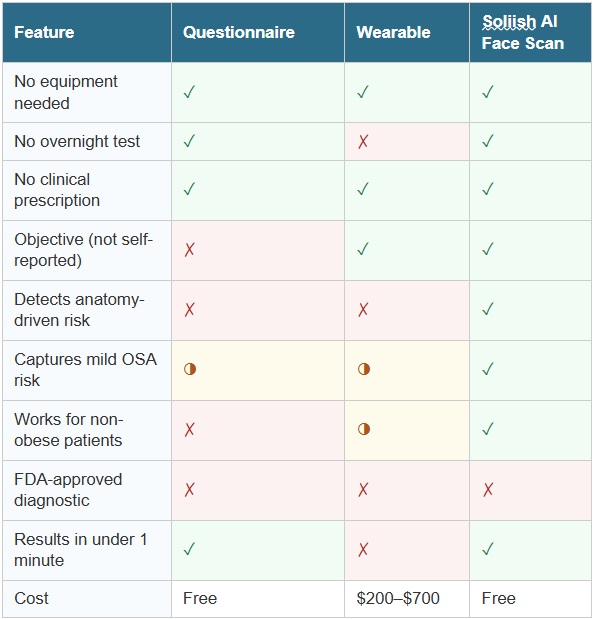
Side-by-side comparison

The table below summarises the key attributes of each screening method. ✓ = strong capability  ◑ = partial / conditional  ✗ = limited or not applicable
Which screening method is right for you?

The honest answer is that most people will benefit from more than one tool at different stages of the screening-to-diagnosis journey. Here is a practical guide:

Start with an AI face scan if…

  • You have not been tested and want an immediate, objective first assessment
  • You are not overweight but have been told you snore or show symptoms
  • You are reluctant to pursue a sleep study but want to know if it is warranted
  • You are a woman (traditionally underscreened by questionnaire tools designed around male symptom profiles)
  • You are a dental or primary care patient and your clinician wants a rapid triage

Add a questionnaire if…

  • You want a quick cross-reference of your symptom profile alongside an objective structural assessment
  • Your clinician requires a STOP-BANG or ESS score for referral documentation

Use a wearable if…

  • You already own a compatible smartwatch and want ongoing overnight monitoring
  • You want to track trends in your sleep quality over weeks and months
  • You have received a moderate-risk face scan result and want additional confirmation before pursuing formal testing

Recommended Pathway: AI face scan → discuss result with GP or dentist → HSAT if indicated → formal diagnosis → treatment. This pathway removes the gatekeeping barrier of the first step while ensuring every subsequent step is clinically grounded.

Conclusion

Every home sleep apnea screening method reviewed here has a legitimate role and honest limitations. Questionnaires are fast and free but subjective. Wearables provide objective overnight data but require the condition to already be causing detectable events. Home sleep tests are the closest thing to diagnostic gold standard at home, but require clinical involvement and are not screening tools.

AI face scanning fills a unique and underserved gap: it provides objective, structural risk assessment instantly, without equipment, without an overnight test, and without a prescription. It identifies the patients most likely to be missed by every other first-line screening method: those whose OSA is driven by anatomy, not lifestyle.

The future of sleep apnea screening is not a single tool, it is a layered, accessible pathway that starts where the patient actually is, and moves them efficiently toward the care they need. An AI face scan is the best place to start that journey.

References

1. Gao EY, et al. (2024). Artificial intelligence facial recognition of obstructive sleep apnea: a Bayesian meta-analysis. Sleep and Breathing, 29(1):36. doi: 10.1007/s11325-024-03173-3

2. He S, et al. (2023). Deep learning technique to detect craniofacial anatomical abnormalities in patients with sleep apnea. Sleep Medicine, 112:12-20.

3. Park JY, et al. (2025). Machine learning model for screening OSA risk using craniofacial photography with questionnaires. Journal of Clinical Sleep Medicine, 21(5):843-854. doi: 10.5664/jcsm.11560

4. Giorgi L, et al. (2025). Advancements in Obstructive Sleep Apnea Diagnosis Through Artificial Intelligence: A Systematic Review. Healthcare, 13(2):181. doi: 10.3390/healthcare13020181

5. Chiu HY, et al. (2017). Diagnostic accuracy of the Berlin questionnaire, STOP-BANG, STOP, and Epworth sleepiness scale: A bivariate meta-analysis. Sleep Medicine Reviews, 36:57-70. doi: 10.1016/j.smrv.2016.10.004

6. Bašić Kes V, et al. (2022). Comparison of five sleep questionnaires for detection of obstructive sleep apnea. PMC / MDPI.

7. Robbins R, et al. (2024). Accuracy of three commercial wearable devices for sleep tracking in healthy adults. Sensors, 24(20):6532. doi: 10.3390/s24206532
8. American Academy of Sleep Medicine (2023). National indicator report on sleep apnea diagnosis and treatment.

9. Peppard PE, et al. (2013). Increased prevalence of sleep-disordered breathing in adults. American Journal of Epidemiology, 177(9):1006-1014. [Lancet global prevalence reference]

Schedule a personalized demo now

Frequently Asked Questions

Find answers to frequently asked questions about our technology and services.

Can I use multiple screening methods together?

Yes and this is often the best approach. Research shows that combining screening tools improves both sensitivity and specificity. For example, Park et al. (2025) found that combining AI facial analysis with questionnaire data significantly outperformed either tool alone. Using an AI face scan alongside a STOP-BANG score gives you both objective structural data and subjective symptom information - a more complete picture than either method provides independently.

Icon - Elements Webflow Library - BRIX Templates

Are consumer wearables accurate enough to replace a sleep study?

No and the FDA is clear on this distinction. FDA-cleared wearables (Apple Watch, Samsung Galaxy Watch) are approved to detect breathing disturbances and alert users to possible sleep apnea, not to diagnose it. Diagnosis and treatment decisions require data from FDA-approved diagnostic devices, interpreted by a licensed clinician. Consumer wearables are screening and monitoring tools, a valuable first signal, but not a finish line.

Icon - Elements Webflow Library - BRIX Templates

Why do questionnaires miss so many OSA patients?

Questionnaires depend entirely on what patients self-report. The problem is that a significant proportion of OSA patients particularly non-obese individuals, women, and younger adults do not present with the classic profile of heavy snoring, obesity, and excessive daytime sleepiness that questionnaires are designed to flag. Their OSA is driven by anatomy, not lifestyle, and they often do not recognise their symptoms as abnormal after years of gradual adaptation. An objective tool that measures physical structure rather than perceived symptoms is essential to closing this gap.

Icon - Elements Webflow Library - BRIX Templates

How does the AI face scan compare to a STOP-BANG score for non-obese patients?

This is where AI face scanning shows its clearest advantage. STOP-BANG includes BMI as a scoring variable and was validated largely in clinical populations skewed toward overweight, middle-aged men. For non-obese patients, who represent 20–30% of all OSA cases, the questionnaire performs poorly because their risk factors are structural rather than metabolic. AI facial analysis directly measures the anatomical risk factors that cause OSA in non-obese individuals, making it a substantially better screening tool for this population.

Icon - Elements Webflow Library - BRIX Templates

Is any of these methods covered by insurance?

In most markets, questionnaires are free and uninsured. Consumer wearables are generally not covered by health insurance for sleep apnea screening. Home sleep apnea tests are often covered by insurance when ordered by a physician for clinically suspected OSA, coverage varies by plan and provider. AI face scan tools such as FaceX by Soliish are generally available as a direct-to-consumer or employer-sponsored resource.

Icon - Elements Webflow Library - BRIX Templates

Our Recent Articles

Get in touch with us

If you need technical help or guidance, we’re just an e-mail away.