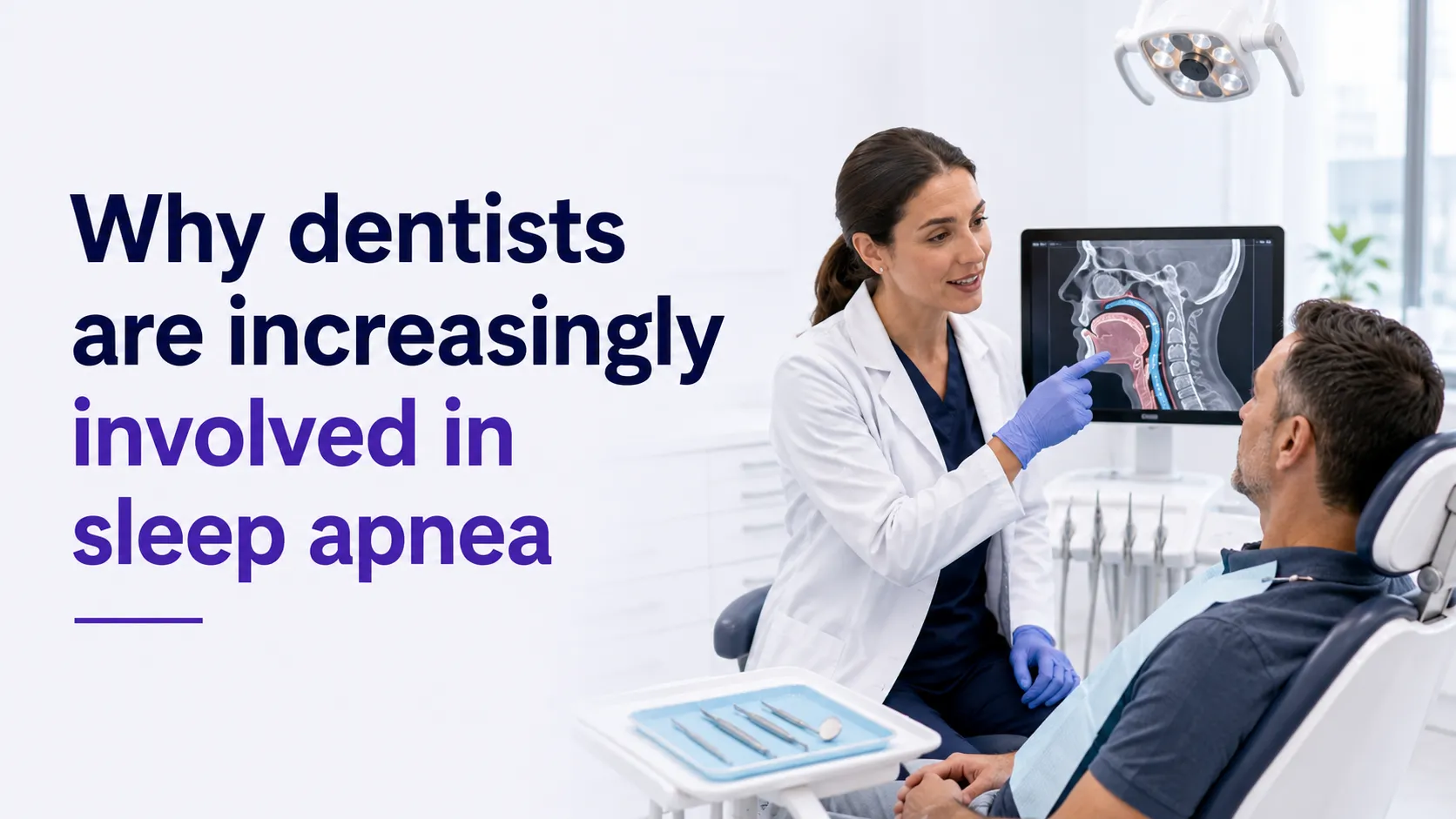
What’s changed isn’t dentistry’s scope - it’s the context around it.
What’s changed isn’t dentistry’s scope - it’s the context around it. Dentists are seeing patients regularly, observing oral structures closely, and building long-term clinical relationships. That combination naturally places dentistry closer to early signs of sleep-disordered breathing, even though diagnosis and treatment decisions remain medical.
This is why dental sleep medicine is becoming more relevant across private practices and DSOs. Not because dentists are taking on a new specialty, but because their existing role increasingly intersects with sleep apnea risk and raises practical questions about what to do next.
This article explores why dentists are encountering sleep apnea more often, and how that involvement has evolved in a way that remains clinically appropriate and clearly defined.
1. Dentists see patients often, and patterns show up over time
Most medical visits are episodic. Many patients don’t see a primary-care clinician regularly, and even when they do, sleep is rarely the focus of a brief appointment.
Dental care is different.
Patients come back at predictable intervals. You see changes over months and years. You also hear “small” comments that don’t always make it into medical charts:
None of these statements diagnose sleep apnea. But over time, patterns like these become hard to ignore, especially when they come up alongside dental findings that often accompany disrupted breathing during sleep.
This is one of the main reasons the phrase dentist sleep apnea is increasingly common: dentists are often the first clinician to hear the story consistently enough for it to feel clinically meaningful.
Dentistry is not sleep medicine. But it has never been disconnected from the airway.
Every day, dental clinicians evaluate how the mouth functions as part of a larger system. Breathing patterns, jaw position, and oral space are not abstract concepts, they influence comfort, stability, and long-term outcomes in routine dental care.
In practice, this means dentists routinely consider factors such as:
These observations are made for dental reasons, not to assess sleep. Yet they sit directly along the same anatomical pathway involved in nighttime breathing.
Because of that overlap, signs associated with sleep-disordered breathing often surface during normal exams, sometimes gradually, sometimes repeatedly. This doesn’t make dentists responsible for diagnosing sleep apnea. Diagnosis still requires sleep testing and medical interpretation.
What it does mean is that dental clinicians are well positioned to notice when something may warrant further evaluation. The growing connection between dentistry and sleep apnea isn’t about a shift in scope; it’s about recognizing that airway-related risk can be visible during everyday care, long before a patient ever seeks medical evaluation.
Another reason dentists are increasingly involved is that dentists already deliver one of the established therapies for obstructive sleep apnea: oral appliance therapy.
This matters because it changed the mental model. Sleep apnea stopped being “a CPAP-only medical issue” and became something where dentistry has a defined clinical contribution after a medical diagnosis and prescription.
That flow is important to state plainly:
Screening is not diagnosis.
Dentists can help identify risk and guide patients to evaluation. Diagnosis remains medical. Treatment decisions follow diagnostic testing and clinical interpretation.
When patients hear there is an option that involves a dental device, many naturally ask their dentist first. That creates more conversations and, over time, more involvement.
Patients today are more aware of sleep than they were even a decade ago. Wearables, sleep scores, and general health content have made people more alert to fatigue and recovery even if they don’t understand sleep apnea specifically.
What often happens in dentistry is subtle: patients don’t walk in asking for a sleep apnea diagnosis. They ask questions like:
Again, these are not diagnostic questions. They’re orientation questions and dental practices are increasingly where those questions get voiced.
This is part of why “sleep apnea dentist” and “dentist for sleep apnea” are now common search terms: patients are trying to map the care pathway, and they start with whoever they see most reliably.
In DSOs especially, there’s growing interest in consistency: consistent documentation, consistent screening prompts, and consistent referral pathways when sleep apnea risk is suspected.
This is not about turning dental teams into sleep clinicians. It’s often about removing ambiguity:
Standardization reduces variability across providers and locations, and it helps ensure that when the topic comes up, the response is structured rather than improvised.
Sleep apnea is treatable, and outcomes often improve when patients are identified earlier. Dentistry contributes because dental settings can surface risk sooner — not through diagnosis, but through consistent contact and early awareness.
This is especially relevant for patients who don’t match the common stereotype of sleep apnea. Some patients are not overweight. Some don’t report obvious daytime sleepiness. Some present with “side symptoms” like headaches, dry mouth, or bruxism that feel dental or lifestyle-related.
When dentists help a patient connect those dots and seek evaluation, the value is simple: fewer missed cases, and a clearer route into appropriate care.
As dentists become more involved, the practical challenge is rarely clinical intent - it’s coordination.
When a patient screens as higher risk, they need a clear next step for medical evaluation. When a diagnosis is made and a therapy is prescribed, communication needs to stay clean between clinicians.
This is the space Soliish is designed for: enabling the handoffs and follow-through across screening, evaluation, and therapy pathways - while keeping diagnosis and treatment decisions in the appropriate clinical hands.
Dentists are increasingly involved in sleep apnea because:
However, none of these requires dentists to diagnose sleep apnea.
It does require clarity: screening is not diagnosis, roles stay distinct, and patients need a smooth way to move from concern to proper evaluation.
That’s the real reason this topic is showing up more often in dentistry — and why it’s likely to keep doing so.